

Digital sustainability means placing the role of technology in a context of three hundred and sixty degrees of sustainable development. It is in this way that it is possible to mediate between the environmental impacts and benefits of digital, and it is in this way that digital itself can represent the indispensable element for enabling important paradigms – for the present, as well as for the future – such as that of thecircular economy.
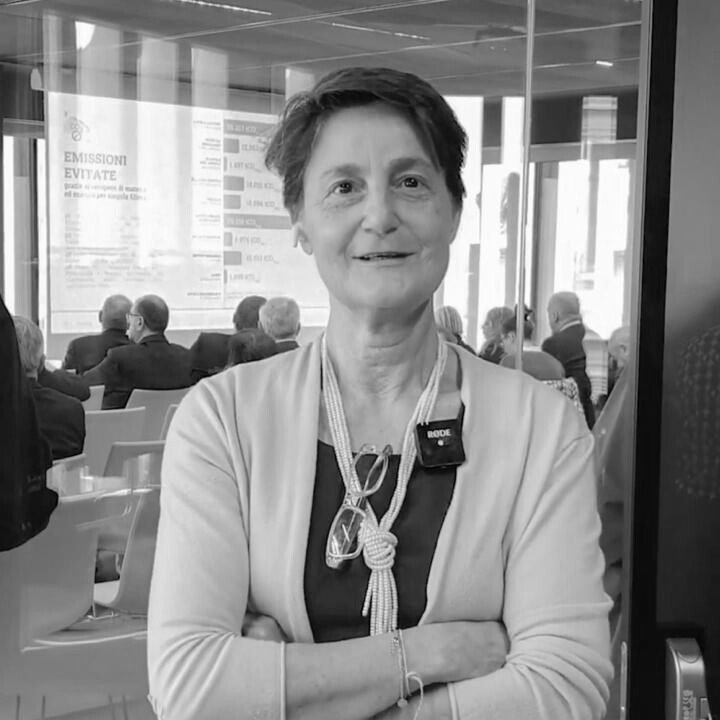
This is the vision of Plures, a new multi-utility of local public services born in Tuscany, which has recently joined the network of the Foundation for Digital Sustainability. We talked about it in this interview with Sara Volino Coppola, Chief Information & Digital Officer of Plures and new member of the Foundation’s Steering Committee: with her experience in the IT sector of utilities, gained also at Hera and Acea, she has led projects of digital transformation, application innovation and redesign of processes and technological architectures. Starting from a technical programming background, he has accompanied the evolution of information systems as a strategic lever for sustainability, operational efficiency and the evolution of business models.
Sustainability as a daily commitment
“For Plures, sustainability is a daily commitment,” began Sara Volino Coppola, highlighting how this focus includes the centrality of the citizen, but also a reduction in the overall impact of the company’s activities. “Obviously there is great attention to the maximum possible recycling of all material, with an ongoing commitment to citizen involvement. For example, we have set up a billing system that, in some municipalities, rewards the ratio between separate and undifferentiated waste collection, giving users an incentive to differentiate to the best of their ability: this leads to a better capacity for recycling, and reuse of recycling. We also pay a lot of attention to reducing environmental impact in several respects: firstly, we have invested in implementations that aim to optimise and reduce the number of kilometres travelled by our collection vehicles. In addition, we enhance interactions with digital channels so as to reduce the indirect footprint of our customers, who can use our services without having to travel to our counters. And then, of course, we have a special focus on the creation of secondary raw materials from waste treatment‘.
The digital that closes the circle
Digital therefore plays a central role for Plures in its relationship with customers. And as told by the company’s IT manager, managing this tool with a view to sustainability is a question of balance, between the impact it generates and the results it guarantees. “Digital sustainability is a complex concept, on which on the IT side we pay continuous attention, trying to mediate between the consumption that comes from digital versus the services we offer. In this sense, we have a long series of initiatives aimed at rewarding sustainable digital-enabled behaviour that helps to ‘close the circle’: we are in fact aiming at closed-loop waste management, and here the consumer becomes almost a producer of a new product, which is the second raw material“.
In this direction, digital technology becomes the crucial element to enable the full realisation of the circular economy model that Plures places at the centre of the management of its services. “In order to realise the circular economy, we have patented special collection systems, such as the Genius 5.0 dumpster, which makes it possible to track for each individual what and when is thrown away, and thus to have a dedicated pricing model, but even more so to work in such a way as to go and empty the bins only when they are full or close to being full, and not according to a planned tour.
We then transformed, and are still transforming, some of our services starting from the idea of going towards the customer, and not expecting them to adapt to our rules,” Sara Volino Coppola continued. “Throughout the served territory, it will soon be possible to book the home service for the collection of goods with a high possibility of recycling: this represents an incentive for citizens to recycle better, and an opportunity to reduce the carbon footprint that would otherwise result from citizens travelling to the collection centres. All of this is supported by a strong digital structure using new technologies, from IoT to data platform and blockchain“.
Towards a shared goal
Environmental sustainability – and not only – therefore passes through the ability to look at digital as a fundamental transformative tool. And it is on this point that, as Sara Volino Coppola emphasised, the vision and goals of the Foundation for Digital Sustainability and Plures meet, to move in the same direction. “Digital sustainability must be understood as an ongoing commitment to leaving the next generation a better world. We, like the Foundation, see digital as one of the main means to achieve overall sustainability: this is the goal we share‘.