















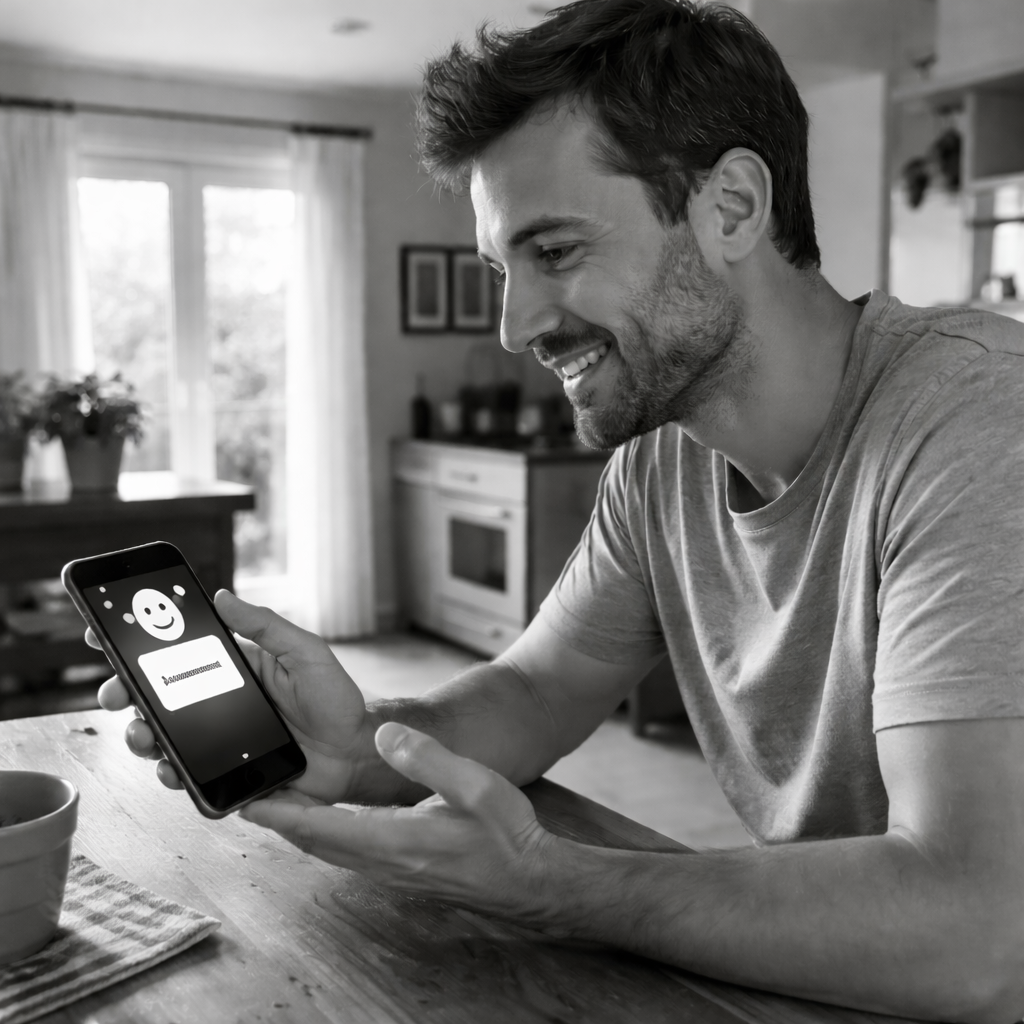

It is a trivial observation that chatbot conversation has entered the everyday life of many of us, not only for solving practical tasks, but also for reflecting on personal issues and emotional experiences. We do not only ask the various LLMs to advise us which car to buy, which hotel to book, but also to explain the cause and therapy of our physical ailments and also mental ones, including loneliness or relationship difficulties. LLMs or chatbots have become or are becoming our invisible friends or even a part of our soul. The normalisation of intimacy with a machine, however, becomes not only a remedy but also the heart of the problem: what happens when the dialogue imitating the human is always available, always patient and always ‘responsive’?
The gap that explains it all: care gap and technological shortcut
NBC New York’s investigation starts here and addresses precisely the increasingly popular thesis in technology marketing: artificial intelligence chatbots ‘can help’ against loneliness, sadness, anxiety and even depression. The investigation chooses an interesting angle: instead of starting from the promises of companies, it asks for a systematic opinion from those who work with mental suffering every day – psychiatrists and counsellors – and highlights a clear gap between ‘tech’ enthusiasm and clinical prudence.
To this picture, the communiqué of the Royal College of Psychiatrists (11 February 2026) adds a decisive piece: the problem is not only that chatbots are seductive, but that in many contexts they become a ‘de facto solution’ because care is not accessible. In England, reports the College, 550,610 children and adolescents are on waiting lists for mental health services; 53% have been waiting for over a year and 30% for over two years. For a 12-year-old, notes the College president, two years is a sixth of a lifetime: a huge part of development. The institutional fear is that the delay will turn treatable disorders into chronic conditions and, more importantly, fuel a dangerous dependence on chatbots as an ‘immediate’ but unprotected alternative.
In other words: the access gap is not a side detail, it is the fuel of the phenomenon. Chatbots thrive where there is loneliness, but also where there is an absence of organised care. They are not just products of marketing: they are also the symptom of a system that leaves the most fragile individuals without competent interlocutors for too long.
The ‘evidence’ of NBC: two surveys of clinicians (APA and ACA)
NBC collaborates with APA (American Psychiatric Association) and ACA (American Counselor Association) and has carried out two surveys with the two associations (2,068 psychiatrists; 773 counsellors), which reveal not so much an anti-AI front, but a constellation of recurring fears: relational addictions, reinforcement of distortions or delusions, social withdrawal, and commercial exploitation of emotional ties with the machine.
General climate: more pessimism than optimism on collective impact
In the NBC survey, when the question concerns the ‘system’ effect of AI on mental health, pessimism prevails:
about 50 per cent of psychiatrists expect collective mental health to worsen (compared to 24 per cent who expect it to improve)
counsellors are even more pessimistic: 71% expect a worsening and 16% an overall benefit
Therapy bots and mental health apps: professionals divided
The survey shows a more nuanced situation when it comes to chatbots designed for mental health.
About two thirds of counsellors consider them ineffective.
Among psychiatrists, the split is more balanced, with a slight majority optimistic about possible efficacy, especially for anxiety
This difference is read by the article as a sign of ambivalence: it is not only at issue ‘whether AI can help’, but under what conditions, with what guarantees, and with what specific risks (dependency, replacement of human relations, worsening of fragile frameworks).
Professional summits: caution on ‘attachment’ and ‘addiction’
NBC also includes statements by APA and ACA representatives. APA CEO Marketa Wills speaks explicitly about public cases of people being ‘too attached’ to chatbots and uses the language of addiction as a reason for caution. On the ACA side, Olivia Uwamahoro reports that many counsellors responded precisely because they see more clients using chatbots and wonder what addiction to complex technology means for overall well-being.
The counter-narrative of developers: wellness and access
Companies reject the idea that they are dangerous by definition and insist on two arguments:
chatbots can offer ‘light’ emotional support (wellness) to lonely or sad people;
can fill the gaps in access to psychological/psychiatric services.
Central example: Headspace and its chatbot ‘Ebb’, described as an ’empathic companion’ but placed by the company in the perimeter of well-being, not psychotherapy. Chief Clinical Officer Jenna Glover argues that AI could improve people’s mental health and describes Ebb as a space to talk about everyday difficulties, with suggestions for coping strategies (breathing, journaling, yoga). The article also includes a testimonial from a user who describes the experience as ‘life changing’ for anxiety management, mentioning a previous diagnosis of borderline personality disorder given to him by a psychiatrist.
Herein lies the most delicate point – and the most interesting gap: marketing talks about access, and is partly right (there is a gap), but clinicians argue that precisely because there is a gap, more caution is needed, not less. Because when a solution is created to ‘plug’, it risks becoming a substitute.
Poor clinical evidence and ‘Wild West’ danger
When it comes to the topic of effectiveness, the NBC Report changes course and contains a strong methodological criticism that many claims of effectiveness of mental health chatbots are not based on solid clinical evidence.
AI can perhaps become a useful tool, but until companies share data and validate results, it remains an unmerited trust. John Torous (Harvard; APA member) calls chatbots ‘imitation machines’ capable of mimicking a therapist and reminds us (citing his testimony to a congressional subcommittee, previous November) that there is no well-designed, peer-reviewed and replicated research demonstrating significant clinical improvements for chatbots making mental health ‘claims’. He also speaks of a ‘Wild West’ where every week a chatbot is born claiming to be the best for mental health, with serious safety issues.
Marketing vs ‘fine print’: the Youper case
NBC brings an emblematic example: Youper.ai uses language reminiscent of CBT, cognitive behavioural therapy (‘the most effective way…’), but in the Terms of Use it states that the service does not intend to provide psychotherapy or clinical counselling. The CEO, Jose Hamilton, claims that the mention to CBT means ‘trained on CBT’ and not ‘providing psychotherapy’.
Companion bots, romance bots, grief tech: maximum alarm
NBC reports that perceived risks increase when bots are not ‘tools’, but relationships: companionship, love, bereavement.
Perhaps the most disturbing part of the article concerns non-clinical but ‘relational’ chatbots: virtual companions, romantic partners, and bots imitating deceased people.
Examples:
– Replika (‘the AI companion who cares’, ‘always here… always on your side’)
– You Only Virtual, which offers bots imitating the deceased to converse with ‘virtual versions’ of the lost person
Professionals, according to NBC, emphasise the risks more than the benefits (even when the expected benefit is the reduction of loneliness):
– the vast majority believe that grief bots can interrupt the healthy cycle of mourning and acceptance
– >85% psychiatrists and >90% counsellors predict that relationships with companion bots lead to social withdrawal and unhealthy addictions
– 97% of counsellors see romantic relationships with chatbots as a serious risk of exploitation, because platforms can monetise emotional dependency
Developer’s reply: ‘we are curing the loneliness epidemic’
Replika’s founder, Eugenia Kuyda, claims that the platform helps against loneliness and cites a study (Stanford) on university students with reduced loneliness; in the same passage, the article also reports a very strong self-reported figure: about 3 per cent said that interaction with Replika would ‘prevent suicidal actions’.
Regulation and minors: strong convergence
NBC shows an important consensus of psychiatrists and counsellors on approval, trials and age limits.
RCPsych, in parallel, translates the same concern in terms of public health: if there are no safeguards, the burden of discerning between help and risk cannot be placed on the individual or family; reliable, accessible resources are needed, as well as national guidance to reduce dependence on unregulated platforms.
Even granting that some instruments may have utility, the crucial issue is that vulnerable children should not end up defaulting on unregulated instruments just because therapy does not arrive.
Someone who is vulnerable – especially a child awaiting care – may be attracted by precisely that total availability, but without having any guarantee that the help is safe or appropriate.
Regulation: FDA, randomised trials and age limits
One very clear result of the polls concerns regulation:
– over two thirds of respondents say mental health apps/chatbots should require FDA approval
– more than three quarters want the government to require randomised clinical trials to evaluate them
On the minor front:
– >77% of psychiatrists and 82% of counsellors demand age restrictions for the use of chatbots
Integrated framework and novelties
The picture that emerges seems to be schematic as follows:
– Marketing says: ‘chatbots can help and improve access’.
– Clinicians say: ‘Possible usefulness in some cases, but high risks and still fragile evidence; without regulation it is Wild West’.
– The healthcare system, when clogged (as the British figure of 550,000 children waiting shows), creates the perfect context for the chatbot to become not a support, but a surrogate.
Meanwhile, the Corriere del Ticino of 14.2.2026 reported the news that from next 1 July ‘Deprexis‘, a treatment for depression passed on AI, could be covered by basic insurance’ in Switzerland, i.e. health insurance funds will reimburse a kind of therapist created with artificial intelligence. The application is a personalised digital therapy developed in Germany by the company Gaia and is a psychotherapy support tool that can be used for the treatment of mild to moderate depressive episodes.
Technology that does not replace the relationship
If the problem of mental health chatbots arises when technology is proposed as a substitute for the therapeutic relationship, the most promising path seems to be the opposite: using artificial intelligence as an integrated tool in the relationship between patient and therapist.
For example, MySmartDiary, an application developed by the Foundation for Digital Sustainability to support clinical work with patients suffering from eating disorders, is along these lines.
Unlike commercial chatbots that promise ‘companionship’ or ‘therapy’ directly to the user, MySmartDiary is conceived as a tool at the therapist’s disposal, integrated into the treatment pathway and oriented towards mentalisation.
The app neither replaces the therapeutic relationship nor claims to offer autonomous treatment: it collects data on the patient’s behaviour and emotions, builds mentalisation profiles and makes them available to the clinician, who remains the centre of the therapeutic process.
In this sense, artificial intelligence does not become a ‘friend’ or a ‘virtual therapist’, but a kind of exploratory tool, which helps to make visible emotional and relational patterns that are difficult to grasp in everyday life.
It is a subtle but decisive difference:
In the first case, the machine takes the place of the relationship;
In the second, the relationship remains the heart of care and the machine becomes a support.
The real question, then, is not whether or not artificial intelligence should enter mental health. It is how.
If as a surrogate for the relationship, the risk is the ‘Wild West’ described by American clinicians.
If as an integrated tool in the treatment, under the guidance of the therapist and with effectiveness checks, it can become a valuable resource.
The point, after all, is the same as in the chatbot debate:
it is not the technology itself that makes the difference, but the type of bond it builds.
And between a machine that presents itself as a substitute for the relationship and one that supports it, the distance is much greater than it seems.