







(i.e.: how we mistook the dragon for the maiden, and are still here celebrating)
This article is written looking over his shoulder. Ellul already wrote it in 1988. If it did not reach you then, it is not his fault. You were probably busy optimising something more urgent. And anyway, don’t worry: many of those who quote it at conferences haven’t read it even now. They copied it from someone who quoted it without having read it, who in turn had copied it from someone who had probably heard about it at an aperitif. This is the food chain of educated ignorance. More sophisticated than plagiarism, because at least the plagiarist opens the book.
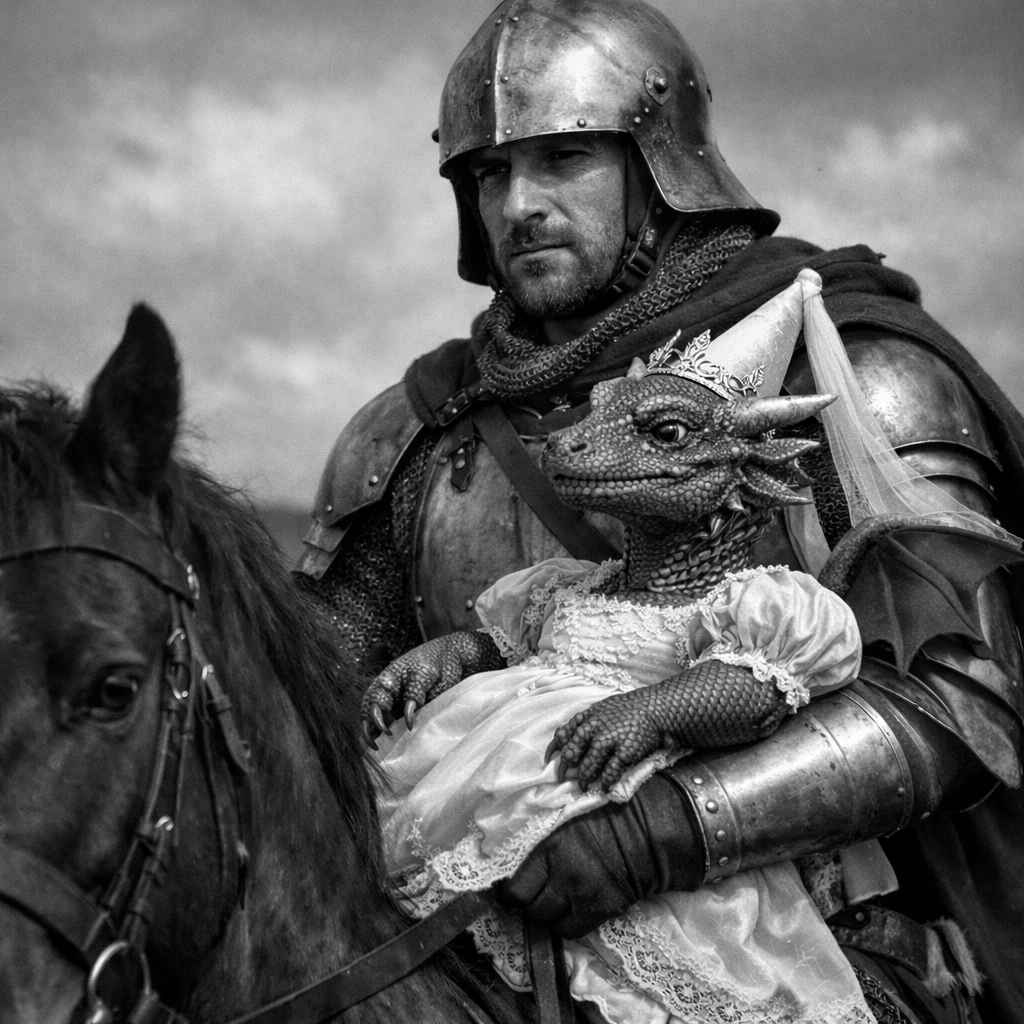
From the towers of his castle, the king saw the knight arrive.
He rode proudly, with the dragon in his arms.
The king shouted at him in despair: “You fool! Your mission was to kill the dragon and take the maiden home!”
The knight smiled. He had optimised the process.
The Prophet no one has read
(or: the bet at the cinema)
There was a French gentleman named Jacques Ellul. In 1988 he wrote a ‘little book’ called Le Bluff Technologique. Seven hundred pages. Sold very little. Almost ignored. Quoted a lot by people who have not read it, who copy from people who have not read it, who in turn quote people who probably heard about it at an aperitif. This is the chain of borrowed intelligence. He has a popular example that is better understood.
“A smartass and a fool are at the cinema.
“I’ll bet euros that the cowboy riding the white horse will fall off,” says the smart guy.
“All right,” agrees the fool.
Five minutes later the cowboy falls off his horse.
“Great!” says the fool. “You won ten euros.”
“I had already seen the film,” confesses the rascal.
“Me too,” replied the fool. “But I didn’t imagine the cowboy would fall this time, too.'”
There. This is our position with respect to the Technique. Ellul had already shown us this film. We know how it ends. And we continue to bet that this time, with this new platform, with this new AI model, with this new digital transformation strategy, the cowboy stays in the saddle.
“We always have more opportunities to live, we live longer, but we live a limited life and no longer have the same life force. We are always forced to compensate for new deficiencies. We are more and more dependent on prostheses and treatments that keep us alive but reduce our capacity to enjoy them.” – Jacques Ellul, 1988
Thirty-seven years ago. When we were buying the first CD and thought it was the future of humanity.
What have we done with this prophecy? Answer: we optimised it. Turned it into a conference. Put it on PowerPoint with its quotes, taken second hand of course. And we moved on. The cowboy fell. We amazed ourselves. Again.
The boomerang and the problem of not knowing what you know
Primitive man invented the boomerang without knowing the laws of aerodynamics. The scientific explanation would come millennia later. The steam engine? Pure achievement of human genius. Thermodynamics did not come to explain it until two centuries later. Technology has always preceded Science.
Then came the moment when Science put itself at the service of Technology. And from that moment on, pure research, the beautiful, useless, free research, practically ceased to exist. Research is only done with the aim of the quickest possible application. Everything must serve something. Everything must optimise something.
The boomerang was for hunting. But it was also for playing. To wonder. To realise that the world could surprise you. Today the boomerang has an IoT sensor, connects to the cloud, sends push notifications and has a premium function for €4.99 per month. Marveling is not included in the basic plan.
If the sick person healed, the credit was given to magic. If he died, it was God’s will. Today: if the algorithm works, it is disruption. If it does not work, it is the fault of the user who does not know how to use it. The principle has remained the same. We just changed the words and increased the price of technical support.
Nowhere man
(The sequel to Jack that nobody planned)
In the previous article, I told you about Jack. Jack of All Trades. A man who could do it all, plant nails, harvest grain, repair engines. A man who had built his identity on work. And whom the system has turned into gold: efficient, optimised, useless.
But there is a next step that I have not yet recounted. What happens after Jack has been made redundant. The Beatles already knew this in 1965.
“He’s a real nowhere man Sitting in his nowhere land Making all his nowhere plans for nobody Doesn’t have a point of view Knows not where he’s going to Isn’t he a bit like you and me?” –
Beatles, Nowhere Man, 1965
Nowhere Man is not a failure. He is the logical outcome of a society that has turned identity into CV, work into metrics, time into productivity. When the CV is no longer worth anything, what is left? What is left is someone who sits in his Nowhere Land, who makes plans for no one, who has no point of view. Because his point of view was built around what he was doing. And what he was doing is no longer useful.
Ellul called it colonisation of the human imagination by machines. When you no longer know what you want unless the algorithm tells you, you are already the Nowhere Man. You don’t even realise it. You simply stopped having a point of view of your own, and started having a feed.
The universal bottle opener
(i.e.: if you have a hammer, the whole world is a nail)
There is a saying attributed to Maslow, that of the pyramid of needs, which is worth more than many treatises on epistemology: if your only tool is a hammer, you will tend to see every problem as a nail. Every great thinker of the 20th century had his hammer.
Marx: the class struggle. Freud : the unconscious. Girard : the mimetic desire. Ellul : the Technique. Everyone sets up their own hammer. And then, inevitably, the whole world becomes a nail.
The world, however, is not just made of nails. It is a cellar full of cans, tin cans, tetrapacks, vacuum-packed bags, coconuts and something that does not yet have a name. The hammer, however ingenious, does not open everything.
Ellul’s point held, however. He was not saying: Technology is evil. He was saying something more subtle and devastating:
“We are forced to constantly make decisions about problems or situations that infinitely exceed us.” – Jacques Ellul, 1988
It is not we who drive Technique. It is the Technique that drives us. Today’s AI is not the carpenter’s hammer. It is the carpenter who hired the owner of the carpentry shop as a part-time assistant. With a project contract, of course. Renewable every six months.
From unlucky to failed
(and from lucky to deserving: the privatisation of everything)
There is a question that hits me like a boomerang: How and why did we move from the expression ‘he was unlucky’ to ‘he is a failure’. For centuries, failure was an external event. The drought. War. Fate. God’s will. Then modernity moved everything in. The problem is not the system. It is you. You are not competitive enough. You haven’t optimised your personal brand. You have not taken the right course.
Ellul called it the end of human priority in choice. I call it the privatisation of collective disaster. The system produces structural poverty, the narrative says it is you who are poor in spirit, the system absolves itself, and you go with the next upskilling course at 299 euros plus VAT.
But there is the reverse, and it is just as devastating. Because the same operation has been done on success.
Plato spoke of the daimon: a voice, a presence, something that inhabited man from the outside and guided him without coinciding with him. Socrates listened to his daimon before making important decisions. He was not mad. He was honest: he recognised that not everything came from him.
The Romans had the genius: a life force that accompanied every man, distinct from his person, which could be propitiated or irritated. The Roman birthday was not a celebration of the individual, it was a celebration of the genius that had chosen to accompany him.
In Naples they have the munaciello: the mischievous spirit who brings good or bad luck, who enters houses, who moves things around, who decides. You did not do well. You didn’t do wrong. The munaciello came by.
In all three traditions there is the same ancient wisdom: it is not just you. Success has causes that transcend you. Failure also. There is something external that accompanies you, that visits you, that you do not entirely control. Call it daimon, genius, munaciello, luck, chance, historical context, the family you were born into. Change the name, it does not change the substance.
Then the market came. And he said: no. It is only you. Every result is yours. For good, to sell you self-improvement courses, books on winning mindsets, coaching at 500 euros an hour. For bad, to owe you nothing when you go down.
We privatised the disaster. But we have also privatised the triumph. With symmetrically disastrous consequences: on the one hand the unbearable guilt of those who fail without understanding why. On the other, the arrogance of those who succeed and believe they have built it on their own, forgetting the daimon, the genius, the munaciello, and every other form of undeserved grace that has accompanied them.
The munaciello at least had the merit of being democratic: he could visit anyone, rich or poor, good or mediocre. Merit, as the market understands it, only visits those who already have a ticket.
“Poor man wanna be rich Rich man wanna be king And a king ain’t satisfied ‘Til he rules everything” –
Bruce Springsteen, Badlands, 1978
Who is the king who wants it all? Today he does not have a crown. He has a board of directors and a business model based on extracting the wishes of others. Same story, different packaging. The munaciello no longer visits him. He has convinced himself that he does not need it.
Technique as a system
(when the means becomes the end and also makes the presentations)
Technology is not neutral. It has become an autonomous system pursuing its own goals – efficiency, speed, optimisation, scale – and we have adapted. We redefined our goals to coincide with those of the machine. And we called it progress.
The paradigms that Ellul identified in 1988 are the same as they are today, only with more bandwidth: the desire to standardise everything; the obsession with change for change’s sake; growth at any cost; the absurdity of working faster and faster; and above all the autonomy of technology, which develops independently of human will.
In 1988 he was describing fax machines. Today we are talking about systems that learn, decide, optimise, and ask us to trust them because they are faster than us. As if speed were proof of wisdom. As if the fastest horse is automatically right about direction.
Technology is exponential. Human perception is linear. The gap between the two cannot be bridged with a course in prompt engineering. It is bridged, if it is bridged at all, by that old-fashioned thing Ellul called consciousness. The one that has no automatic updates.
The market as predator-prey
(and the gentle leadership that doesn’t add up)
Vito Volterra studied the relationships between predators and prey in nature. An oscillating system: predators increase, prey decreases, predators decline due to lack of food, prey recovers, cycle begins again. A dynamic, unstable balance, never definitive.
Then it was realised that this model also described the market. And this is where it gets interesting, and a little uncomfortable.
In the market, the game is still zero-sum. One wins if he takes a customer away from his opponent. Two leaders compete on results: if one loses, he loses share, he loses turnover, he loses position. The prey, the customer, is at the centre. Highly visible. Contestable. Every quarter.
Then someone will have to explain to me what kind leadership means when my success depends structurally on my taking business away from you. I can be gentle in doing so. I can use beautiful words, shared values, corporate purpose. But at the end of the day, if you grow, I have lost. And if I grow, you have lost. We are still in a zero-sum world. Kindness is packaging. The hammer is still the hammer. And the customer is still the nail.
This does not mean that kindness is useless. It means that it is insufficient as long as the rules of the game remain the same. You can be the most polite predator on the savannah. But the savannah is still a savannah.
Ellul had a name for it: colonisation of the future. Technology does not only optimise the present. It occupies the imaginary of the possible future. It narrows the space of what we can conceive of as an alternative. When the zero-sum market becomes the only conceivable model, you stop imagining others. And at that point the system is safe.
“Living is easy with eyes closed Misunderstanding all you see” – Beatles, Strawberry Fields Forever, 1967
What should we see, with our eyes open? This is the only question that Technique cannot optimise. Because the answer is not a datum. It is a choice. And real choices are uncomfortable, slow, and cannot be measured in KPIs.
Government 2.0 and other stories told at the bar
(with excellent Wi-Fi and no liability)
People are talking and reading about this beautiful project. It is called Government 2.0. A leaner, smarter state, smart contracts, algorithmic procurement, policies tested with AI simulators. I like it. It is seductive. It is the institutional equivalent of the universal bottle opener.
The problem is not the idea. The problem is that we are describing a technical solution to a problem that is not technical. Who decides the procurement algorithms? Who controls the policy simulators? Who owns the data on which the AI trains? Who responds when the algorithm gets it wrong?
These are not technical questions. They are political questions. And it is exactly the kind of question that Technology tends to render invisible. Because it turns choice into optimisation. And optimisation has no ideology. It only has KPIs. KPIs measure what is convenient to measure.
The old bureaucracies do not disappear. They turn into algorithmic bureaucracies. With the difference that the old bureaucracy had a manager you could tell to fuck off. The algorithm has no phone number. It only has an error screen.
Tail: the knight, the dragon, and the maiden we lost track of
Back to the knight with the dragon in his arms. He is not stupid. He is not evil. He is rational. He optimised the mission based on the available incentives. The dragon was easier to catch than to kill. The maiden was in an inconvenient place. The optimal route led to returning with something spectacular.
The system rewards the knight who returns with the dragon. It punishes the knight who returns with empty hands after fighting an invisible battle. It does not have the ability to evaluate that which cannot be measured. And the maiden, for the system, is not measured.
Ellul said: the gurus, the experts, like the seer read the future but are unable to cure the disease. They can only eliminate the symptoms. No one can lead the way for us.
“Man can free himself from the burden of technology provided he is fully aware of the danger.” – Jacques Ellul
Perfectly conscious. Not moderately concerned while scrolling through the feed. Not vaguely informed between cocktails and conferences. Perfectly aware. Against a system designed exactly to prevent it.
“You say you have got a real solution Well you know, we’d all love to see the plan” – Beatles, Revolution, 1968
The plan has been missing for fifty-seven years. The smart ones have already seen the film. They know how it ends. They have already placed the bet. That leaves the fools who continue to marvel when the cowboy falls. At least we are amazed. At least we still feel something. Or maybe that’s optimism too.
The question Ellul took to his grave unanswered:
Is the maiden still out there?
Or have we convinced ourselves, over time, that it never existed?
— — — — — — — — — —
P.S. – Ellul wrote in 1988 that information technology was unifying all subsystems, allowing them to become a single structured organism that lives within society, manipulates, transforms and exploits it. He was describing the Internet four years before it existed. Someone should have listened to him. We were busy optimising something more urgent.
P.P.S. – All those who quote Ellul without having read it are requested not to mention it in the comments. Not out of respect for Ellul. But because it wouldn’t change anything. And he already knew that.
P.P.S. – “Isn’t he a bit like you and me?” The Beatles again. Yes. A bit. Yes.
P.P.P.S. – I have a background in the ‘academy’. On the first day, the legendary Baron would gather the new assistants and say: ‘Guys, remember that copying from one source is a crime. Copying from many sources is research…Copy, copy and remember to cite sources” Pause. “More importantly, remember: try to copy from the good ones.” This whole article is a tribute to that advice. We tried to copy from the good ones. Ellul was among the good ones. Too bad few actually read it.