









Prophets of the future, theologians of the Antichrist and patrons of the present
Peter Thiel in Rome is not an obvious image, and for this very reason it has aroused a flurry of questions and assumptions.
Not because the city is alien to technology – Rome has gone through two thousand years of technological, political, legal and cultural innovations, resisting them 😉 – but because Palantir’s founder belongs to a world that has moved its centre elsewhere: between California, digital platforms and invisible data infrastructures.
Yet Rome remains an extraordinary place. Here, for centuries, power has sought something that wealth or military might alone could not provide: symbolic legitimacy.
As Michele Kettmaier recently observed, Thiel did not arrive in the capital like a pilgrim. Rather, his journey appears as an attempt to situate technological power within a genealogy much older than the digital revolution. Rome has always been this: the place where power presents itself not only as force but as destiny.
And perhaps it is no coincidence that it was here that one of Silicon Valley’s most powerful entrepreneurs chose to speak of the Antichrist.
Billionaires as thinkers of destiny
For some time now, some of Silicon Valley’s most powerful entrepreneurs seem to be engaged in a curious symbolic metamorphosis. It is no longer enough to be founders of technology companies or holders of immense wealth. It is also necessary to appear as interpreters of the fate of the species.
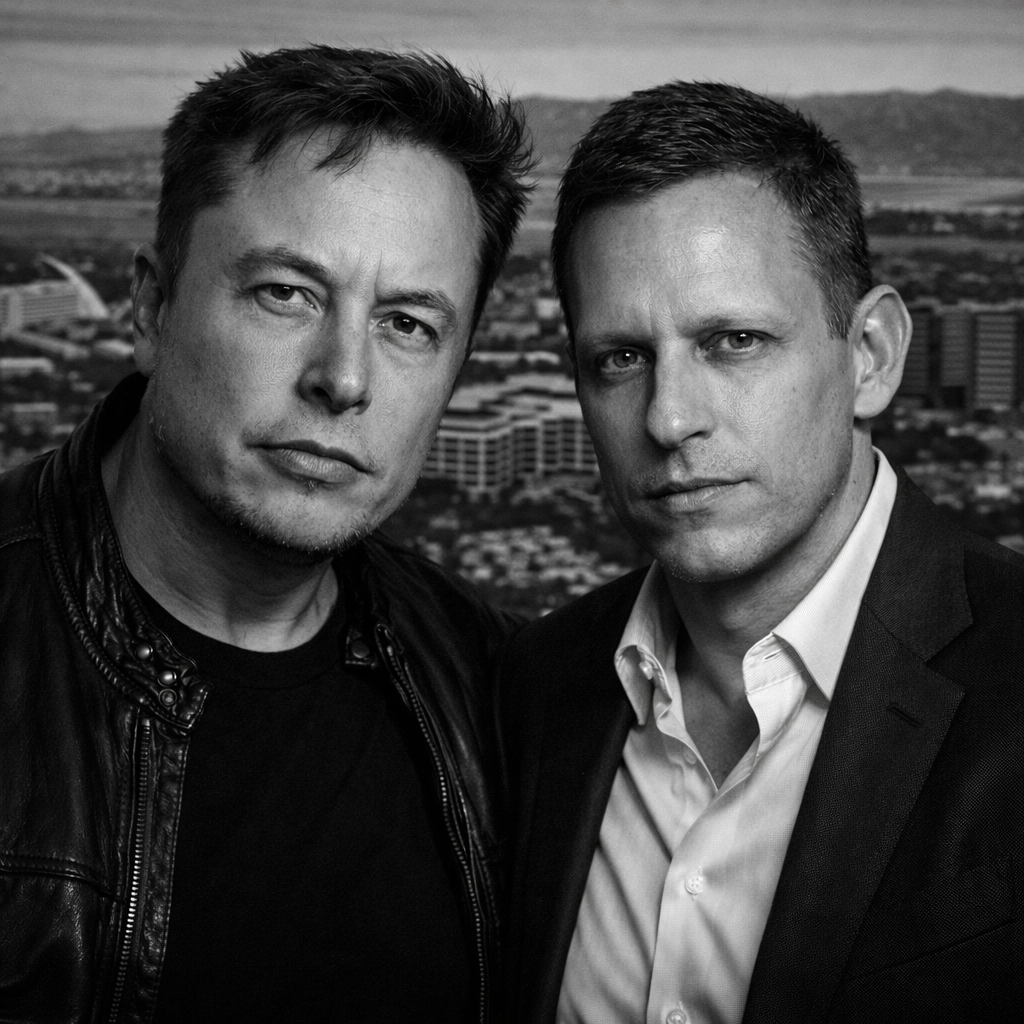
In this sense, Elon Musk ‘s interest in longtermism and Peter Thiel ‘s interest in the figure of the Antichrist appear, at a closer look, as two variants of the same identity movement.
Longtermism , developed within the framework of effective altruism, argues that the moral priority of our time is to positively influence the distant future of humanity. In this perspective, the prevention of so-called ‘existential risks’ becomes the main ethical task of our time.
As I have already written on this blog, logtermists, or at least many of them, are not content to think about grandchildren and great-grandchildren but want to take care of all the generations that will come after us, so much so that ‘if you could prevent genocide in a thousand years, the fact that ‘those people don’t exist yet’ would not justify inaction” or again “if you could save a million lives today or prevent a 0.0001% chance of premature human extinction – a one-in-a-million chance of saving 8 billion lives – you would have to opt for the latter”. Finally, as Nick Beckstead, a member of the Future of Humanity Institute, argues: ‘Saving lives in poor nations may be less useful than saving lives in rich nations’. The Future of Life Institute ‘ is also part of the long list of longtermist institutions. After ChatGPT’s first disruptive impact, it published an open letter in which Elon Musk, together with 999 other scientists, researchers, managers, and IT experts, warned mankind of the dangers of artificial intelligence, even calling for a six-month moratorium. Only to later develop his own, Grok, among others accused of being anything but ethical. Elon Musk, while openly embracing longtermism, is not a theorist of it, but rather presents himself as an entrepreneur of the biological and cosmic future: children against demographic decline, Mars against terrestrial extinction, AI as risk and at the same time as acceleration. In him, the ‘cure for the future’ takes a highly personalised, almost genealogical form: not just future humanity, but continuity of civilisation through reproduction, expansion and selection of capabilities.
Peter Thiel, also one of the richest and most powerful men on earth (thanks to Paypol and the financing of many other successful sturt-ups), grey eminence of the American radical right and supporter of Trump from the very first hour as well as the architect of his victory and the choice of numerous protégés in top positions of the Trump government (starting with Vance as Vice-President), follows a seemingly opposite but structurally similar path. In his lectures in recent years, he has developed a political-theological theory according to which the Antichrist would not be a supernatural figure but the political form of a global power that, by exploiting collective fears – from climate change to technological risks – would promise peace and security at the price of freedom.
Peter Thiel’s theological framework: Antichrist, Apocalypse and ‘katechon’
Thiel calls himself a Christian and interprets contemporary history from an eschatological perspective. According to him, humanity is caught between two opposing risks:
– Armageddon: destruction of civilisation through nuclear war, biotechnology or other catastrophes.
– Antichrist: establishment of a totalitarian global political power that promises ‘peace and security’ but eliminates freedom and innovation.
To avoid both drifts, Thiel evokes the katechon, a concept from Paul’s Second Letter to the Thessalonians. In the letter, the apostle mentions a mysterious force that ‘holds back’ the appearance of the Antichrist and delays the end of time. In later centuries many theologians interpreted this force as the Roman Empire: an imperfect power, but one that was necessary to prevent apocalyptic chaos from overwhelming the world.
The idea resurfaced several times in European history, up to its modern reinterpretation by the German pro-Nazi jurist and political scientist Carl Schmitt, who saw the katechon as the political function of those powers capable of delaying historical catastrophe.
Thiel argues that every era has its own katechon, for example anti-communism during the Cold War.
The decisive influence of René Girard
Behind Peter Thiel’s interest in the figure of the Antichrist is also the intellectual influence of the French philosopher René Girard, with whom Thiel studied at Stanford University.
Girard had developed a theory of human violence, according to which many conflicts arise from mimetic desire: human beings desire the same things because they imitate the desires of others, and this imitation generates rivalry and violence. To contain this violence, societies have often used the scapegoat mechanism, blaming conflicts on a sacrificial victim.
Thiel applies this theory to the Apocalypse by reinterpreting the figure of the Antichrist, which he envisages not as an apocalyptic monster, but as a power that promises to eliminate universal violence while concentrating ever more total authority in its own hands.
The Antichrist as ‘World State
In its contemporary interpretation, the Antichrist is a centralised global political system, characterised by global governance, technological regulation, global climate policies, and strong supranational institutions.
Technology and Antichrist
According to Thiel, technology can be an antidote to the Antichrist. He therefore argues that blocking or over-regulating AI or innovation could foster the emergence of that centralised global power, which is for him the ultimate evil. It is a position that many commentators call ‘techno-eschatology’: a theology of salvation through technological innovation.
The polemical use of the figure of the Antichrist
In some private conferences (2023-2025) Thiel also suggested that anti-technology movements, radical environmentalism, and AI regulation might act as ‘precursors’ or ‘legionaries of the Antichrist’, going so far as to point to Greta Thunberg or Eliezer Yudkowsky as incarnations of such legionaries.
Added to this is the fact that Peter Thiel, who does not hesitate to make the decidedly undemocratic argument that only a technocratic oligarchy could effectively govern nations.
Many religious and political scholars find Thiel’s theological-political approach problematic. Stanford professor Adrian Daub, has described Thiel’s lectures on the Antichrist as ‘amateurish’ and contradictory, perhaps dictated by a desire to divert attention from the power he wields in the technology sector. Other scholars observe that the political use of the Apocalypse tends to delegitimise the democratic process and turn political opponents into eschatological enemies.
The fate of the species
The two visions, Musk’s and Thiel’s, seem to move in different directions: Musk looks to the future extinction of humanity, Thiel to the global totalitarianism of the present. But both have a common feature: they shift the moral discourse from the political to the quasi-eschatological plane.
In psychoanalytic terms, it is not so much a matter of compensating wealth with philanthropy as Bill Gates does (I own a lot, so I give a lot back), but of converting power into destiny. In fact, Thiel and Musk go one step further: they do not just say ‘I do’, but implicitly ‘I see further than others’. This is what is really at stake in their identity construction. They are talking about the fate of the species.
The symbolic metamorphosis of power
From a psychological point of view, this is fascinating.
Extreme wealth inevitably creates a tension of identity: the subject knows he possesses enormous power but, at the same time, feels the fragility of his legitimacy. For centuries, the classic response to this tension has been philanthropy: accumulating wealth and then giving some of it back to society.
Silicon Valley seems to have invented a more ambitious variant. No longer benefactors but philosophers of the future.
The technology entrepreneur presents himself as one who, thanks to his privileged position at the heart of innovation, possesses a broader vision of the trajectory of civilisation. He not only builds companies but also interprets the meaning of history.
The paradox of control
Thiel describes the danger of a global power capable of freezing freedom in the name of security. But at the same time he is the co-founder of Palantir, one of the world’s most powerful companies in the field of data analysis and surveillance.
The paradox is obvious. In the name of freedom, he takes total surveillance upon himself.
The theory of the Antichrist can then also be read as a narrative through which he not only symbolically detaches himself from the power he wields, but also makes his presence and action of control, surveillance and ultimately power necessary on the basis of an even eschatological principle.
Three Silicon Valley archetypes
If one observes this constellation of figures with an almost anthropological gaze, three archetypes emerge.
Elon Musk appears as the demographic and cosmic prophet: he talks about the survival of the species, the colonisation of Mars and the existential risks of artificial intelligence.
Peter Thiel instead takes on the role of the political theologian of technology, who uses the language of Christian eschatology to interpret the conflict between freedom and globalisation.
Alongside them is the figure of the oracle of artificial intelligence, embodied by technology leaders such as Sam Altmann who present AI as a threshold capable of redefining man’s place in the world.
Bill Gates, on the other hand, belongs to an earlier generation; he does not speak of Antichrist or colonies on Mars. He does not pretend to interpret the remote destiny of the species. His response to extreme wealth is more traditional: philanthropy. He is the patron of industrial modernity.
The mythologies of power
Musk’s longtermism and Thiel’s Antichrist are not just philosophical or theological theories. They are personal mythologies of technological power.
Through these narratives, the great digital entrepreneurs perform a twofold operation:
They transform economic power into a form of moral or spiritual authority and construct a new public identity that removes them from the all too simple figure of the plutocrat.
They are no longer just men who accumulate capital. They become interpreters of the future of humanity.
And perhaps it is here that the psychological core of these visions is revealed: extreme wealth produces a growing distance from real society. Bridging that distance requires a narrative that transforms power into mission.
Thus the billionaire ceases to be simply rich.
It becomes – at least in one’s imagination – necessary to the species.