

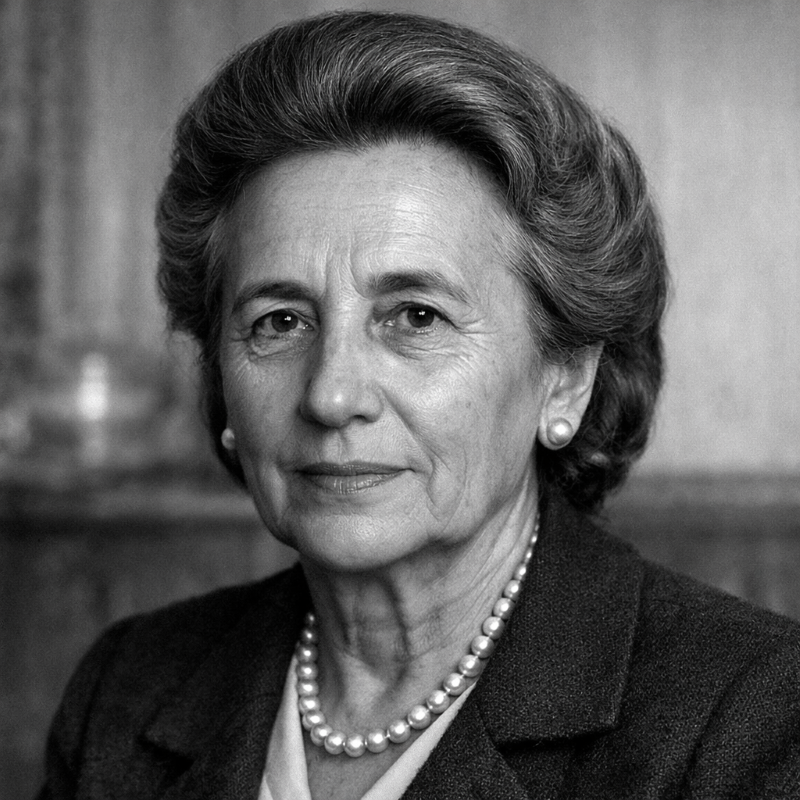

Easy to be the most prestigious scientist in the world if you are the wife of a dictator
If you think the worst of science is plagiarism, data manipulation or fraudulent conferences, then you have never heard of Elena Ceausescu. For decades she has come to be regarded as one of Europe’s greatest chemists, honoured halfway around the world, revered as ‘Professor, Doctor, Engineer’ by an entire nation. The problem is that she knows nothing about chemistry. Nothing. Not even the formula for sulphuric acid.
An awesome school curriculum
Born in 1916 under the name Lenuța Petrescu in a village in Wallachia, Elena left school early: at 14 she was already in Bucharest, employed in precarious and poorly paid jobs. One of her former teachers kept the report card with which the girl had collected almost only failures for decades. So much for a bright academic career: Elena does not even manage to complete her basic education.
But saving her from mediocrity is the Romanian Communist Party. She attends it assiduously and there she meets Nicolae Ceausescu, whom she marries in 1947. When he takes power in 1965, she is one step away from the top, but there is one problem: Nicolae does not want to share the leadership. And, in any case, what role can an almost illiterate woman play in the heart of the communist apparatus?
The invented scientist
For Elena, personal prestige comes through science. At a time when communist ideology exalted science as the engine of progress, nothing could be more effective than an academic career to build a credible image. So she enrolled in an evening chemistry course at the Bucharest Polytechnic. But she is expelled after being caught cheating during an exam. The teacher who denounced her would later recount that she lived in terror for the rest of her life.
In spite of everything, Elena obtained a doctorate in chemistry in 1967, with a thesis on the polymerisation of isoprene. But the public discussion speech, compulsory by law, never takes place. The law is changed especially for her. When the public presentation of the thesis is scheduled, the citizens who came to see only a sign: ‘the discussion has been brought forward to 6 a.m.’. Nobody saw or heard anything. But the title of doctor of chemistry is official.
An institute in his image and likeness
In 1970, Elena became director of ICECHIM, the prestigious National Institute for Chemical and Petrochemical Research. Her name appears as first author on dozens of scientific publications. None of which she has ever written. Entire research groups are forced, under duress, to sign studies with her name at the top. One researcher, Mircea Corciovei, would testify (but only after the fall of the regime): ‘We wrote articles with terms she could not even pronounce’.
Elena never attends scientific meetings, nor does she correct a single word of the publications she signs. When a colleague shows her an elementary formula (H₂SO₄), she cannot read it. And when she talks about carbon dioxide, she calls it ‘CO-doi’, earning her the mocking nickname Codoi, which means ‘long tail’ in Romanian. Of course, everyone makes fun of her, but only in private: no one dares to correct her in public. That would be suicide.
Elena demands to be called by all her titles – Professor Doctor Engineer – and wants complete control of national scientific research. And she gets it: at the end of the 1970s she is president of the National Science and Technology Council. He decides who can publish and who cannot. Who can make a career and who is removed. In communist Romania there is no room for competence: there is only room for obedience.
Yet, that is not enough for her. She doesn’t just want to dominate the Romanian academy. She wants international recognition. And so the diplomatic pressure begins.
Buffet Honours
If you are the dictator’s wife, certain things become easy: when relations are built in Romania with a foreign country, the protocol must also include an academic award for Elena, otherwise no deal. Take it or leave it.
In 1974, the University of Buenos Aires awarded her an honorary doctorate. The following year she receives two more awards in Tehran and Amman. Everything is meticulously orchestrated: every official trip abroad must include a ceremony in which Elena receives a new medal, a new degree, a new certificate.
During a visit to the United States in 1978, Ceausescu became furious when she was offered an award by the Illinois Academy of Sciences: ‘I’m not going to Illi-coso! I want an award from Washington!” she shouts according to former intelligence chief Ion Mihai Pacepa. In the end, he accepts the ‘B’ medal in disgust, even hurling an anti-Semitic insult at the academy’s president, the ‘dirty Jew’ Dr Emanuel Merdinger.
In the same year, another episode characteristic of her modus operandi takes place in London. The Romanian embassy presses British universities to award her an academic title before an official visit. Romanian affairs expert Dennis Deletant strongly advises against it, but the Royal Society of Chemistry and the Polytechnic of Central London give in to the pressure. Ceaușescu is granted honorary membership and an honorary professorship. The Royal Society will only let it be known forty years later, in 2021, that that honorary membership disappeared with the change of statute in 1980.
He who climbs too high, makes more noise when he falls.
When the regime collapses in December 1989, hungry and angry crowds invade the dictator’s palace. In the eighty rooms, they find solid gold taps, jewellery, chandeliers and tapestries from the world’s powerful. But what is most striking are complete collections of Chanel dresses repeated in all shades, all rigorously matched with matching shoes and bags, piled up in Elena’s budoir.
Elena and Nicolae are captured, summarily tried and executed. In the courtroom, during the trial, a prosecutor asks her: “And who wrote them, all those scientific articles, Elena?“. The woman does not answer. But there is no need. Everyone knows the truth by now.
His academic empire was a gigantic mise en scene. Built on the authority of fear and maintained through the systematic falsification of reality. For decades, no one dared contradict her. No one dared to say that chemistry cannot be improvised.
Almost forty years later, Elena Ceaușescu’s name still appears in scientific articles, theses and monographs published by leading publishers such as Elsevier, Taylor & Francis and Wiley. A group of scholars, led by Chris Isloi and Andrei Dumbrava, has launched a campaign to erase her name from every publication and revoke the honours she never deserved. ‘The problem,’ Isloi explains, ‘is that no one has ever thought about what to do when the author is the ignorant wife of a dictator.’
Elena Ceaușescu’s is not just a story of arrogance and ignorance, but a warning: when science bends to power, truth ceases to matter. And competence is replaced by fiction, by appearance, by fear. His legacy is a mutilated science, polluted by bogus titles and invented merits.
When power allies itself with ignorance, truth is silenced and science becomes a tool in the service of appearances. Elena Ceausescu is not only an example of how falsification can thrive in collective silence, but a warning to all: science must not be bent to the logic of power. Can anyone think of other, more recent episodes?