



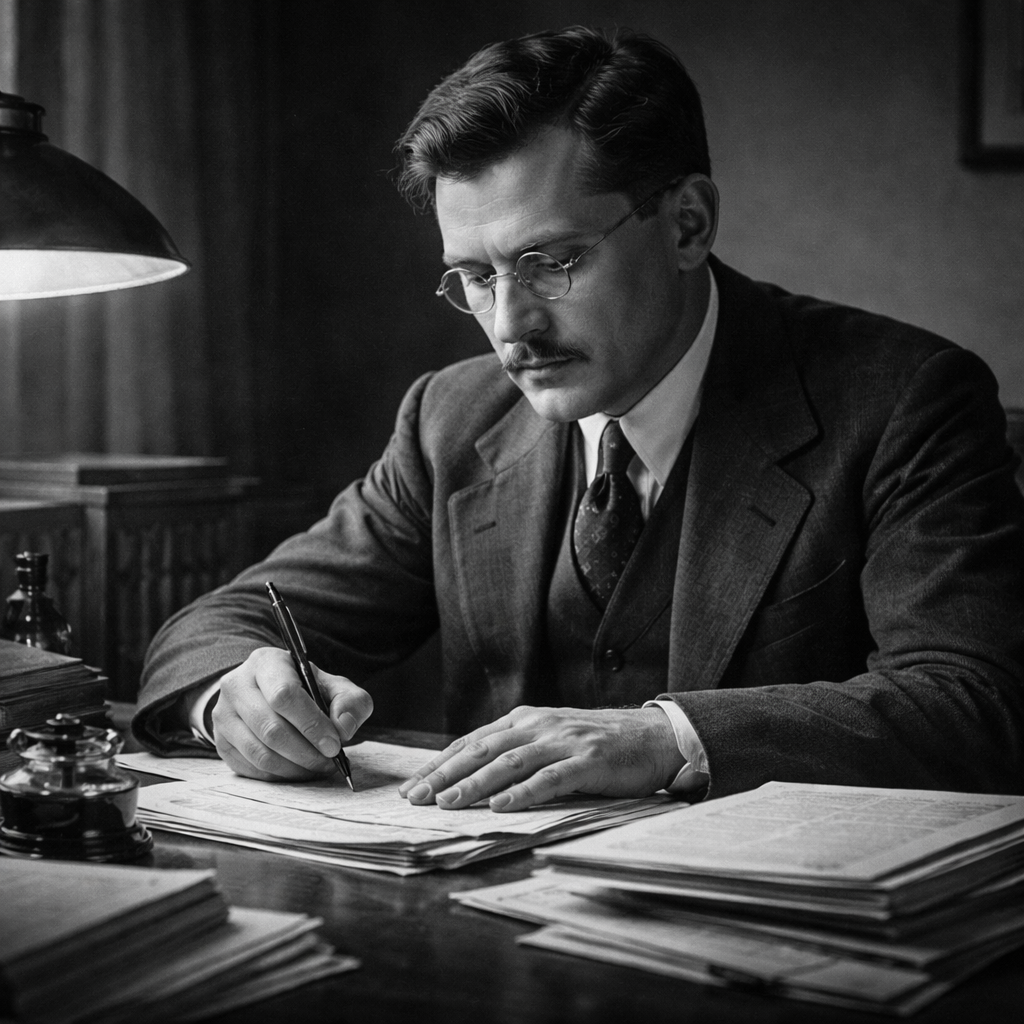

Nikolai Kondratiev had a problem. Kondratiev, not Houston. Because Houston had a technical problem, solvable, with a crew still alive. Kondratiev had a system problem. The kind of problem you don’t solve – you go through.
He had realised something true, and said it out loud. In 1925 he published a study in which he argued that capitalism did not march in a straight line towards eternal progress – as the Soviet vulgate wanted – but moved in waves. Long, slow, inexorable waves. Every forty, fifty years: a technology is born, the economy changes, society changes, a crisis arrives, it all starts again.
Stalin did not appreciate this. He was shot in 1938.
But he was right. And today anyone who talks seriously about technological innovation – even those who don’t know who Kondratiev was – is using exactly his scheme. Rail. Electricity. Oil. Information technology. Digital platforms. Artificial intelligence. Six waves. Six times the same story with different costumes.
The moral? The truth about cycles is dangerous. Not for those who ride them – for those who name them.
Let’s hold that thought for a moment. I’ll come back to it.
Because I had an idea that was probably wrong, almost certainly excessive, and therefore impossible to ignore. What if Kondratiev’s waves were just one chapter in a much longer story?
In the beginning
In the first six days, someone – call him what you will, God, the Big Bang, the Force, the Adjacent Possible made person – shapes the universe. It separates light and darkness. It creates earth and water. It establishes time. It sets the first wave in motion. On the seventh day it stops.
It is not rest in the sense in which we understand it – Netflix, sofa, silence. It is something more disturbing. It is the plateau. The high point of the first cosmic S-curve. The moment when creation has reached its installed capacity and is waiting for someone to do something with what is there. Man picks up the baton on the eighth day. And here begins our story – which is, on closer inspection, Kondratiev’s story told on a geological scale.
Day eight: the fire. The first startup without a pitch deck
Five hundred thousand years ago. First technology. First wave. Adoption time: a few tens of millennia. No venture capital involved.
Day nine: the wheel. The first outsourcing
3500 BC. First automation. First time man realises that he can delegate physical effort to something that does not get tired. The wave takes thousands of years to unfold.
Day 10: Writing. The first analogue artificial intelligence
3200 BC. First artificial memory. First time thought survives the thinker. The wave takes centuries.
Day eleven: steam, electricity, oil
Here Kondratiev enters the scene and starts taking notes. The waves get shorter, more intense, more violent. Fifty each. Then forty. Then thirty.
Day 12: silicon
1947. Birth of the transistor. The digital era is born. The wave lasts twenty years, maybe less.
Day 13: Artificial Intelligence
We are here. Now. And the wave – if it is a wave – seems to last for years, not decades. Maybe months. Do you see what is happening?
Kondratiev’s waves compress. From fire to the wheel: hundreds of thousands of years. From the wheel to writing: a few thousand. From silicon to AI: decades. From AI to what comes next: maybe we won’t even have time to name it. We are accelerating towards something. And the curve describing this acceleration is not linear – it is itself an S-curve. A meta-wave. The wave of waves. Kondratiev had found the pattern. He had not yet seen that the pattern applies to himself. And on the eleventh cosmic day – or the fourteenth, who counts anymore – God wakes up.
He gets up from his millennial rest, looks at the table, sees what we have built, reads our reports, studies our AI, observes that we have started to rewrite DNA, to build intelligences that debug themselves, to produce life as we launch a product on the market. And… he doesn’t destroy anything, he doesn’t intervene, he sits in silence.
In music, it is called the cadence of deception. It is the same mechanism as a good joke – you build up the expectation, cultivate it, take it to the limit, and betray it exactly when the brain has already prepared itself to laugh at something else. The harmonic progression takes you towards the expected resolution – what musicians call the authentic cadence, the arrival home, the tonic, the V-I – and instead at the decisive moment veers elsewhere. It is not an out of tune. It is a wrong resolution in the right place. It leaves you suspended in a balance you had not anticipated.
Philosophers are familiar with it, even if they call it something else. Kant constructs for hundreds of pages a perfect rational system and then puts the thing-in-itself – the noumenon – exactly where the ultimate answer should be. You get to the door and the door doesn’t open. It is not a mistake: it is the structure. Hegel does the same with dialysis – thesis, antithesis, synthesis – but the synthesis is never a point of arrival, it is always a new beginning disguised as a conclusion. Every answer is a question in a good suit.
There is another cadence of deception worth mentioning. The evolutionary one.
The lion and the zebra have been facing each other for millennia. The lion studies, memorises, refines strategy. The zebra studies nothing – it simply resets when it returns to its lair after the confrontation. The next day it changes direction without knowing it, without having decided, without having lost sleep over it. The lion comes prepared to the old zebra and finds a new zebra. He remains dry-mouthed. And he gets an ulcer. The zebra does not get an ulcer. The lion does.
Because ulceration is not the price of defeat – it is the price of intelligence. It is what happens when a system complex enough to learn from mistakes encounters a world unpredictable enough to make that learning a dead end. Memory becomes a burden. Experience becomes a trap. And here the cadence of deception becomes fierce: we expect intelligence to be an absolute evolutionary advantage. Instead it is a conditional advantage – it works as long as the world remains predictable enough to be learned. When the world changes faster than we can learn, intelligence backfires. It produces anxiety instead of solutions. It produces ulcers instead of prey. Kondratiev knew this. He too had learnt too well the old pattern The cadence of deception does not deny resolution: it always moves it one step further and you cannot turn back. Its silent presence is not an answer, it is a question that no one yet has the courage to formulate fully. The exact same question that Kondratiev did not have time to ask before he was shot: this wave – where does it end?
In the following pieces I will try to take a closer look at those who have tried to answer us We have already met some of them. Jacques Ellul, who said in 1954 that technology is self-feeding and does not ask permission. Paul Virilio, who said that every technology brings its own specific shipwreck. Ted Kaczynski, who said the same things as the other two and then made questionable choices. Next will be Marshall McLuhan, who said that the medium is the message – and hardly anyone understood that, including him. And then Neil Postman, who said that we were drowning in our own abundance of information. He said this before the internet. Again, bad timing.
Because after so many prophets of the apocalypse – people who saw the waves coming and shouted from the shore – it was worth meeting someone who built the waves. A great creator, by counterpoint. Someone who instead of warning laid bricks. A pause in the catalogue of bad masters, before starting again. But there is one thing that none of them made time to see. And that changes everything. Kondratiev saw the waves as sequential. One ends, the other begins. Orderly, almost reassuring. But what is happening now is not a new wave – it is two waves arriving simultaneously and starting to interfere.
The sixth wave, that of artificial intelligence, is not succeeding the fifth. It is overlapping with biotech, synthetic genetics, CRISPR, catalogue babies and lab-built organs. Silicon learns to think at the exact moment biology learns to reprogram itself. Synthetic intelligence and synthetic biology: two waves converging towards the same point.
Two waves silicon learns to think while biology learns to rewrite itself: same impact point When two waves meet they have only two possibilities: they amplify, or they destroy. Kondratiev had no name for it either, for the time being. But the thirteenth day – whatever it is – is coming faster than anyone predicted. Even faster than God (or whoever) expected, probably.
Kondratiev was rehabilitated by the Soviet Union in 1987. Fifty years after his death. His waves were already in their fifth iteration. The sixth was about to begin. The seventh is not waiting. And we may not recognise it.