













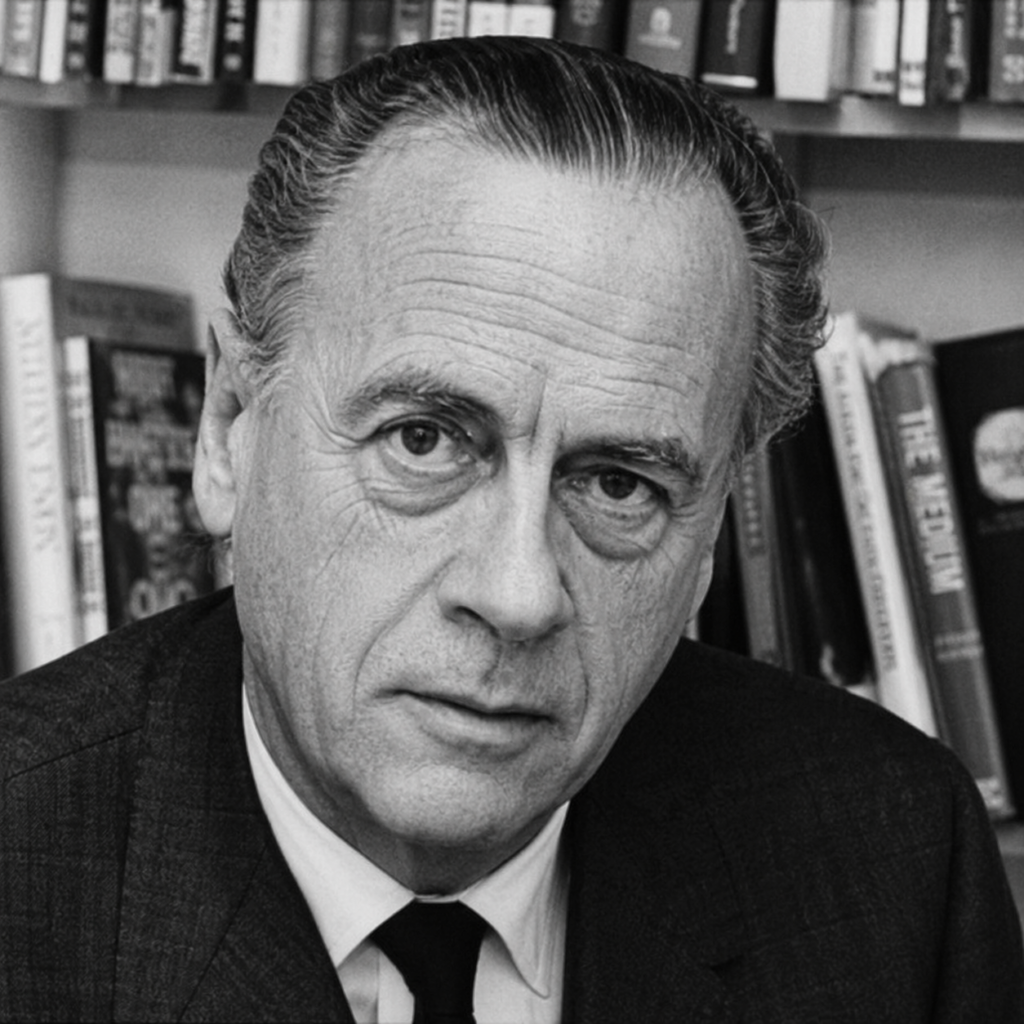

McLuhan predicted the global village. The global village has arrived. And in the global village nobody reads it anymore.
A lecturer tells his students that men have become selfish.
“Yesterday, from the restaurant, I saw a car run over a man. A crowd stopped to watch. Nobody did anything. When we came out… he was still there.”
Pause.
“We were at the restaurant.”
The global village has not made us closer. It has made us better spectators. Marshall McLuhan put it in a way that seemed an elegant provocation at the time: the medium is the message. Today we can afford a less gentle translation: the medium is the environment. And like all environments, we stop seeing it the moment we start breathing in it.
McLuhan was not interested in content. He didn’t care what we said. He cared what we became as we said it. For this he had constructed a simple and brutal tool: tetrads.
Every technology amplifies something, makes something else obsolete, retrieves something from the past, and ultimately turns itself inside out. Always. Without exception.
The refrigerator amplifies the availability of food, makes fresh food obsolete, recovers the leisure of those who cook, and reverses itself into the homologation of flavour. The clock amplifies work, makes idleness obsolete, recovers history as an art form, and reverses into an eternal present. The camera amplifies private aggression, makes privacy obsolete, recovers the past as the present, and flips into the public domain. Three examples. Three reversals. Three promises kept… in reverse.
Social networks amplify connection. They make silence obsolete. They reclaim the gossip. And they turn themselves upside down into continuous noise.
The global village is not a square. It is a phantom traffic jam. Everyone talks, no one listens, and no one knows who started it.
There is another thing McLuhan understood that we never make clear enough. Each medium does not kill the previous one. It gives it limits. Radio did not kill newspapers – he told newspapers how far they go. Television did not kill radio – it told radio who it is. The Internet did not kill television – it gave it a mirror. The old medium survives. Smaller. More precise. More itself.
The problem is that no medium knows its limits until the next one comes along and defines them. We are inside the internet. And we still don’t know who will come along and tell us how far we go. Every time something new comes along, someone says it will kill the old one. It never does. It only reshapes it.
The right question is not: what will survive? It is: who will come to tell us who we were? Do you want a real time tetrad?
On 17 and 18 September 2024, thousands of pagers exploded in Lebanon. Not missiles. Not drones. Pagers. Those little things buried in the 1990s along with high-waisted jeans and 56k modems.
The network amplifies belonging – you are on the network, therefore you exist. It renders secure communication obsolete – the connected device is by definition an exposed device. It reclaims the 1970s letter bomb, the suspicious package, the analogue trap. And it reverses itself into the perfect weapon: it does not kill the shooter, it kills the one who belongs to that network.
McLuhan would have drawn it on a blackboard. With satisfaction.
The target is no longer the person. It is the network. It is not globalisation. It is reticularisation. And in the network, it is not the individuals that count: it is the nodes that count. It does not matter who you are. It matters which node you belong to. The global village is not a square. It is a minefield where no one knows where they have stepped. Because we have stopped seeing people. We only see connections.
But the interesting part of tetrads is not what they amplify. It is what happens at the end, when they flip. Because the flipping is not an accident. It is the final stage of functioning. And this is where the most interesting thing happens.
Because the first to turn around was McLuhan
The theory that explained the media has been rendered invisible by the media itself. The man who predicted the global village became irrelevant at the precise moment the global village arrived. It is a perfect tetrad, and it has the bitter taste of things coming true in the wrong way: McLuhan amplifies the understanding of the media, renders the traditional way of analysing it obsolete, recovers an almost tribal form of perception – immediate, simultaneous, sensory – and flips into invisibility. The medium has become so pervasive as to render those who had understood it useless.
There is a scene in Annie Hall, 1977. A university professor explains McLuhan out loud, in a queue at the cinema, getting him completely wrong. With that academic confidence that he does not need to understand to explain. Woody Allen breaks the fourth wall, complains to the audience, and then pulls McLuhan himself out from behind a sign.
McLuhan looks at him and says: you have understood nothing of my theories.
The professor replies: I teach a course on her.
McLuhan: worse.
Today we no longer need to pull McLuhan out from behind any signs. Because the professor has won. Not because he is right. But because the medium he lives in no longer requires him to be wrong or right. Media no longer transmit content. They transmit conditions. They do not tell us what to think. They tell us what kind of environment to think in. And in that environment – as notifications scroll by, as the feed updates, as you are reading this article on a device that McLuhan would have analysed while using it – the difference between understanding and not understanding slowly ceases to matter.
McLuhan has not been superseded. It has been absorbed
Ellul had said that the technique is autonomous. Kaczynski who is self-propelled. Virilio speeding up to become an accident. McLuhan adding the last variation: and eventually it turns around. Four bad masters. Four movements. A single out-of-tune orchestra still playing, louder and louder, in a village that has long since stopped listening. And in the meantime, while the global village is telling itself, someone has started to plunder it. When a theory is absorbed into the environment it describes, a curious thing happens: it stops sounding like a theory.
It becomes air. And when you breathe an environment you no longer see, you don’t even notice when it changes.
P.S. Each medium does not kill the previous one. It measures it. It gives it its contours. The problem is that no medium knows what his own are until the next one comes along and defines them. We are inside something. And we don’t yet know what the next one will call us.
P.P.S. Every time something new comes along, someone says it will kill the old one. It never does. It only redesigns it. The old one survives. Smaller. More precise. More itself.
P.P.S. The next time you use a tool, ask yourself one thing: who is using who?