

I have been working on the subject of communities (digital and otherwise) for over twenty years, and I have learnt enough to know that constructing shared meaning is one of the most difficult things there is, much more difficult than books on the subject seem to suggest, including my own, published when the term Business Community was still almost exotic in the Italian debate. Not because the theory is wrong, but because of the fact that the distance between understanding how a community works and succeeding in generating an authentic one is one that no model can completely bridge.
And that is why every year, looking at what happens in Monopoli at the end of May, I am increasingly amazed and fascinated by the proof that social miracles do exist.
The Monopoly is back. Fifth edition. And every year it amazes me with something that I struggle to explain with the tools I usually use.
Mauro Minenna and Salvo McGraffio did something seemingly simple: they took a musical instrument that hardly anyone knows how to play, brought it to a provincial town in Puglia and said ‘come, we will teach you’. Free entry, workshops open to beginners, no skills required, no selection. Mauro, who is also vice-president of the Foundation for Digital Sustainability and one of my best friends, does not usually like easy definitions. Yet when he talks about Monopolele he always uses the same words: community, encounter, beauty. Not as slogans, but as a description of what really happens when you create the right context.
There is already, in this, something worth emphasising. On the surface it seems a paradox: the ukulele is among the simplest instruments in existence, four strings, instant tuning, and in a couple of hours anyone can produce something that resembles music. Perhaps from a distance. Yet hardly anyone plays it, and it is not a problem of access, nor of cost, nor of technical difficulty. Something more subtle is missing: the initial spark, that moment when the abstract possibility of doing something becomes the concrete desire to do it.
The Monopoly has learnt to produce exactly that spark, bringing the right people together in the right place, lowering the threshold between ‘could’ and ‘will’ until it disappears, so that the simplicity of the instrument can finally do its job.
It is a paradox that I know well, because I encounter it all the time when thinking about digital sustainability: accessible technologies that are not adopted, available knowledge that is not used, changes that do not happen. The reason, almost always, is not the difficulty. It is the absence of awareness, of the right context, of that moment when something clicks. And the thing I have learnt, over the years, is that the click does not only come with more information, nor with better arguments.
Having said that, it must be made clear what is meant when it is said that the Monopolele works. ‘It works’ risks evoking a well-oiled organisation, a few enlightened sponsors covering the costs. The reality is just a little different, and for that very reason more significant: what works is Mauro and Salvo’s stubborn willpower.
It is a torrent of volunteers working out of passion without anyone having convinced them of anything. It is the support of a few far-sighted institutions that have understood the value of what is happening and, in equal measure, the resistance of many others who have not yet realised it.
It is a miracle in the precise sense of the word: something that should not hold up according to the ordinary laws of organisation and resources, but instead holds up because there are people who believe in it enough to keep it going with their own hands, year after year. And perhaps that is what makes it interesting to observe, as well as to support.
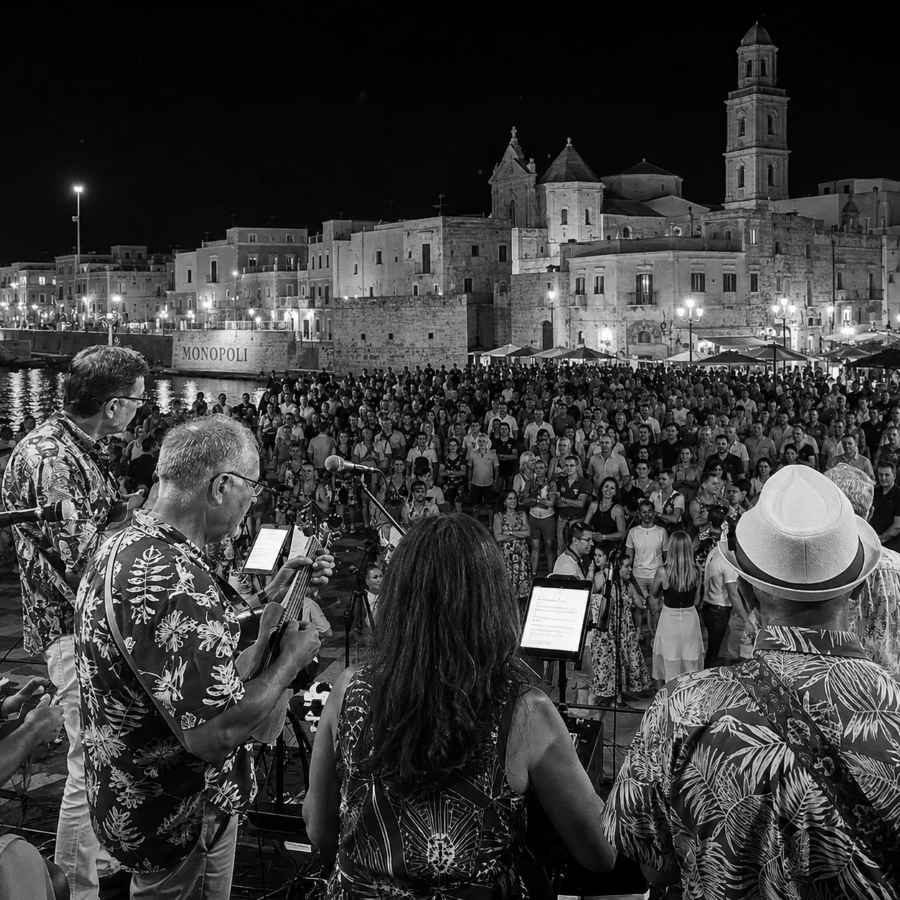
The festival works, after all, not because attendance is growing and media resonance is increasing, although both can be seen and have happened to such an extent that Monopolele has won the title of the best ukulele festival in the world (yes: there are many. No: this is not a joke. Yes: for enthusiasts, it’s serious. No: there are not a few. Yes: they come from all over the world, literally). It works because it generates real participation, not figurative participation. People don’t come to watch. They come to play.
It is a distinction that haunts anyone seriously working on the transformation of collective behaviour. You build platforms, produce content, organise events, publish research. And success is measured in downloads, views, likes: metrics that say how much has been consumed, but don’t say much about how much has been made our own. The question we should be asking ourselves instead is whether we are generating genuine participation or passive consumption, whether we are building community or audience. The difference is not technical: it is cultural, it is a question of model before tools.
Monopolele has chosen the right model. It has chosen a language with a deliberately low entry threshold, and this choice is not an operational compromise: it is the heart of the project. It has chosen gratuitousness as a value, the city as a diffuse stage instead of a closed and manned space. Choices that speak of an idea of community, not just an idea of event.
There is one fact that I have never explicitly mentioned when talking about Monopolele, and which instead seems relevant. The festival was born in 2022, as the world was emerging from the first phase of the pandemic. The Foundation for Digital Sustainability was born shortly before, out of the same urgency to do something useful at a time when the future seemed to have shrunk to the immediate and when it was easier than usual to forget to think big. This is not a coincidence that interests me only on a symbolic level, because it says a lot about the kind of projects that arise at certain moments in history. Not out of calculation, but out of need; not out of strategy, but out of the conviction that certain things must be done because they are right, regardless of how much the system around them is ready for them.
And it is precisely because I know that origin that I can afford to ask a question that is not rhetorical. Is a model like that of Monopolele, founded on the passion of two people and the generosity of a community of volunteers, a model that is sustainable over time? I do not ask this to question what Mauro and Salvo have built. I ask it because it is the question I believe should be asked of anything that works thanks to the sacrifice of those who believe in it rather than thanks to a system that supports it. I ask it also because it is a question that concerns me closely, in the most literal sense: Mauro is not only the founder of Monopolele, he is one of the people with whom I share the Foundation’s work every day, and the question about the resilience of models founded on the sacrifice of those who believe in them is not, for me, an abstract question.
Sacrifice is a precious resource, and it is not infinitely renewable. When it runs out, or when the lives of two people simply change, what depended on it is in danger of dissolving with surprising rapidity. And that would be a shame, not only for the festival, but for all that the festival has shown to be possible.
The question is whether certain models need to institutionalise themselves without losing their soul in the process. The question is whether institutions that have so far looked the other way can begin to look in the right direction. The question is whether the community generated by an experience like this is strong enough to become infrastructure itself instead of remaining public. It is a question that concerns Monopolele, but it also concerns all projects born of a conviction rather than a system: those that work ‘in spite of’ rather than ‘thanks to’. And as long as the answer remains entrusted to the personal hold of those who founded them, the problem arises.
In reality, the Monopolele is not a model to be replicated: it is a mirror to look into, showing what happens when something of value arises from need rather than from the system, grows through the strength of those who believe in it, and reaches the point where the question of its own sustainability can no longer be postponed. Not because it is coming to an end. Because it would be wrong for it to continue to depend only on those who started it.
The Foundation for Digital Sustainability has been a partner of Monopolele for a few years now, and the link was not born out of strategic reasoning. It was born out of friendship, esteem, the shared feeling of working on the same problem from different directions: they with four strings, we with data, research, standards, manifestos.
The objective, when you look at it, is identical: to build communities that have the tools, and above all the desire, to navigate the complexity of the present without losing their bearings. Communities capable of being together oriented towards something that matters, instead of simply being connected by a platform that keeps them in touch without them really knowing each other. Connection is a necessary condition, not a sufficient one. We have been writing this for years. Monopolele proves it every summer, without having to write it down.
As I write, the fifth edition has begun: five days, free concerts, open workshops, artists from all over Europe and the Mediterranean converging here to do something together that they could not do alone. It is also a metaphor, of course. First of all, though, it is a real thing happening in a real place, with real people who choose to be there.
And from Monopoly, every year, we learn something that the data alone would not have taught us.
