
















Every now and then I re-read my ‘bad teachers’. Uncomfortable characters. Pessimists. Over-the-top types. People who would ruin any innovation conference within the first seven minutes. Perhaps they wouldn’t even turn up.
One such figure is Ivan Illich. A philosopher, priest and radical thinker. A man who, back in the 1970s, wrote things that would give half of Silicon Valley a headache today.
His central idea was simple and devastating: institutions created to help human beings almost always end up rendering them incapable.
This is not a provocation. It is a clinical diagnosis. And it is worth revisiting it, because the patient has changed. But the illness remains the same.
The school that destroys learning
Illich put forward a view that still infuriates headteachers today: at a certain point, school ceases to educate. Instead, it begins to foster a dependency on the educational institution.
You no longer learn out of curiosity. You learn to gain qualifications. Knowledge becomes bureaucracy. Learning becomes conformity. And a society that confuses education with training will, sooner or later, inevitably end up loving algorithms.
If he were alive today, he would probably look at certain educational AI platforms — the ones that guide you step by step, that correct you before you’ve even made a mistake, that optimise the learning journey by eliminating the hard work — and say, with that resigned patience of unheeded prophets: ‘Be careful.’ We’re automating curiosity too.”
Medicine that destroys health
This is the most provocative argument. Illich argued that, at a certain point, modern medicine causes more illness than it promotes health.
He called it iatrogenesis. The very system that heals gives rise to new illnesses. Not out of malice. But because of the way it is structured. He was not against doctors. He was against a society that completely delegates its relationship with its own body to specialists. A society that ceases to know itself. A society that learns not to trust its own sensations without certified validation.
To put it in today’s terms: as soon as a technology becomes indispensable, we slowly begin to lose our independence.
Transport that undermines mobility
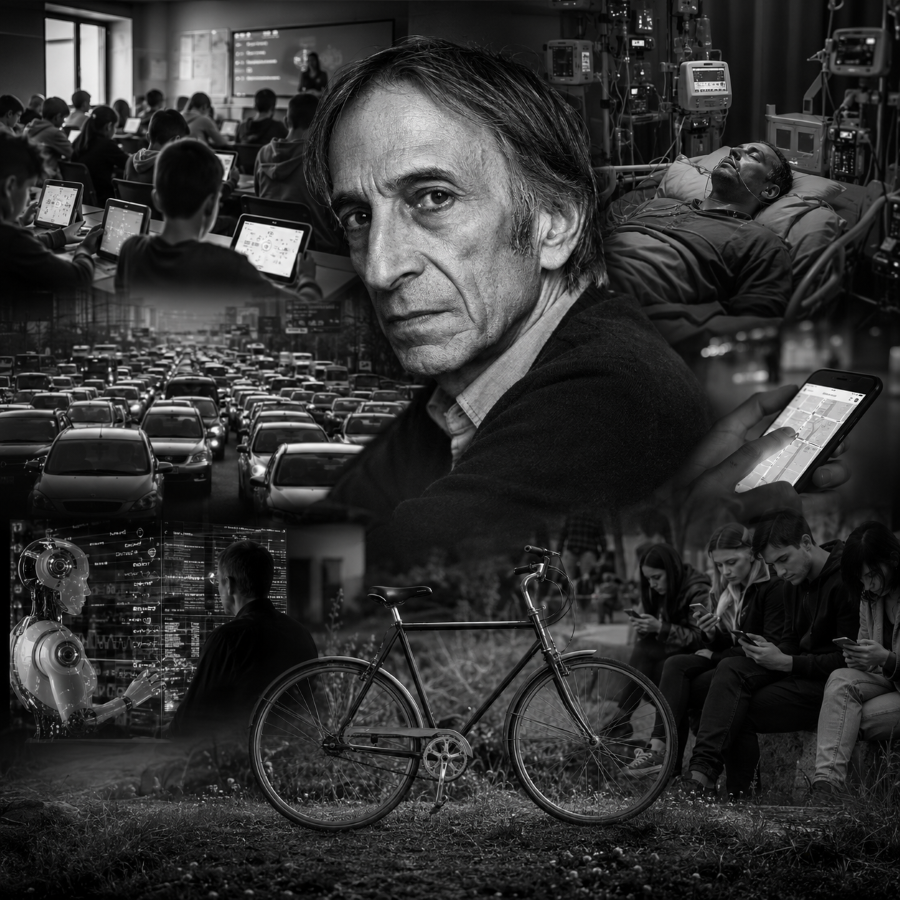
This is perhaps his most elegant insight. And his most vexing one. Illich calculated that if you add up the time spent in the car, the time spent working to pay for it, the time spent in the garage, in traffic, and looking for a parking space — the average person moves at the speed of a man on foot. Technology designed to speed up life actually consumes it.
It was 1974. Nobody was listening to him. Motorways were springing up everywhere. And now we’ve reached 2026. Here, Illich suddenly becomes relevant to the present day. It’s almost uncomfortable to read his work again.
Because if you update the list:
– school → undermines independent learning
– medicine → destroys the body’s self-awareness
– transport → undermines genuine mobility
– social media → destroy relationships
– GPS navigation → disrupts your sense of direction
– streaming platforms → they destroy choice
– AI → risks destroying our ability to think
Every item added is a prophecy he hadn’t made. But one he would have recognised straight away. The mechanism is always the same: the tool designed to help you becomes indispensable. And the moment it becomes indispensable, you’re already hooked.
User-friendly tools
This is where many people get Illich wrong. They see him as a technophobe. A nostalgic. An enemy of progress. He was none of these things. Illich distinguished between tools that enhance human autonomy and those that create dependency. He called them convivial tools. The bicycle, for example, is convivial. It empowers you without replacing you. You can go further, faster. But it is still you who is pedalling, deciding the direction, feeling tired and taking a rest. The bicycle does not know you. It does not optimise you. It does not suggest alternative routes based on your user profile.
Many digital technologies work the other way round: the more you use them, the more indispensable they become. The more indispensable they become, the harder it is to do without them.
The less you can do without it, the less you are able to manage without it. The circle closes. Silently. To your complete satisfaction.
The real problem with AI
So perhaps the right question isn’t the one that makes the papers sell.
The question is not:‘Will AI become conscious? ’ It is: ‘Will humans remain capable of thinking?’
Because a society that delegates everything to machines risks losing, slowly and without realising it:
– memory
– attention
– imagination
– doubt
– even inner silence
It’s not the machines’ fault. It’s for our own convenience. Convenience as an ideology. Comfort as a subtle form of surrender.
Bad teachers are always like that. They exaggerate. They provoke. They oversimplify. But every now and then, they see the future coming long before anyone else does. And perhaps the real problem isn’t that they were wrong. It’s that they were right too soon.
· End of the first episode. In the second: Andy Capp, the anarchist of idleness, and why he might be the social tool that Illich failed to foresee.
P.S. — Illich didn’t have a smartphone. And not out of any philosophical choice: it was 2002, and he died before then. But I’m fairly sure that if he’d had one, he’d have used it to make a call. And then he’d have switched it off.
P.P.S. — He did have a bike.